Summary of chapter six - Edgar Josué Casarrubias Cárdenas 7A
10 Fundamentals of convection terms
The glossary contains vocabulary and key concepts from the summary of Chapter 6 of the book 'Heat Transfer a practical approach' to get familiar with the terminology.
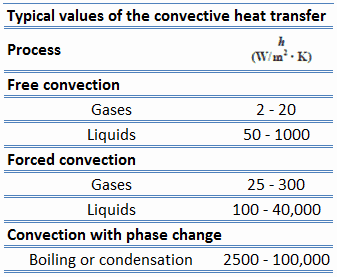
Convection heat transfer coefficient
Noun.
An experimentally determined parameter whose value depends on all the variables influencing convection.
Example: The air motion in convection ovens increases the convection heat transfer coefficient.
es: Coeficiente de transferencia de calor por convección.
Critical Reynolds number
Noun.
The Reynolds number at which the flow becomes turbulent.
Example: The value of the critical Reynolds number is different for different geometries.
es: Número crítico de Reynolds.
Friction coefficient
Noun.
The ratio of the frictional force resisting the motion of two surfaces in contact to the normal force pressing the two surfaces together.
Example: The friction coefficient is an important parameter in heat transfer studies.
es: Coeficiente de fricción.
Kinematic viscosity
Noun.
The ratio of dynamic viscosity to density. Also known as a measure of a fluid's internal resistance to flow under gravitational forces.
Example: Kinematic viscosity can be viewed as viscous diffusivity or diffusivity for momentum.
es: Viscosidad cinemática.
Laminar flow
Noun.
The highly ordered fluid motion characterized by smooth streamlines.
Example: The friction drag coefficient is independent of surface roughness in laminar flow.
es: Flujo laminar.
Nusselt number
Noun.
The ratio of convection heat transfer to fluid conduction heat transfer under the same conditions.
Example: The larger the Nusselt number, the more effective the convection.
es: Número de Nusselt.
Prandtl number
Noun.
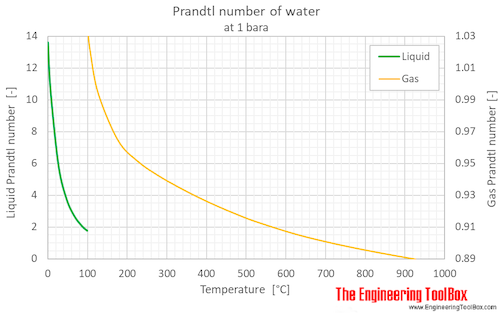
The ratio of molecular diffusivity of momentum to molecular diffusivity of heat.
Example: The Prandtl numbers of fluids range from less than 0.01 for liquid metals to more than 100,000 for heavy oils.
es: Número de Prandtl.
Reynolds number
Noun.
The ratio of the inertia forces to viscous forces in the fluid.
Example: At large Reynolds numbers, the inertia forces are large relative to the viscous forces.
es: Número de Reynolds.
Shear stress
Noun.
Friction force per unit area.
Example: The shear stress for most fluids is proportional to the velocity gradient.
es: Esfuerzo cortante.
Turbulent flow
Noun.
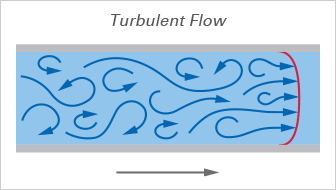
The highly disordered fluid motion that typically occurs at high velocities characterized by velocity fluctuations.
Example: The transition from laminar to turbulent flow does not occur suddenly.